

As part of the United Arab Emirates University (UAEU) Summer Program at Universitas Gadjah Mada (UGM), held from 21 to 25 September 2026 in collaboration with the Ministry of Higher Education, Science, and Technology of the Republic of Indonesia and the Embassy of the United Arab Emirates, UAEU students spent the third and fourth days of the program discovering Yogyakarta beyond its role as a tourist destination, as a place to learn about heritage, culture, nature, and community. Centered on the theme “Bridging Culture and a Sustainable Future,” the program featured workshops on local wisdom, immersive community experiences in Pentingsari Tourism Village (covering batik, gamelan, and plowing), and studies on cultural preservation and disaster mitigation at Borobudur and Mount Merapi.

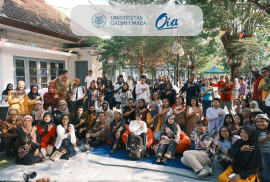
On Day 3 (Wednesday, 23 September 2026), the program began with a visit to Pentingsari Tourism Village, where the students took part in a community immersion activity focused on sustainable rural development. Rather than simply observing, they were introduced to local traditions through hands-on activities, including making batik, playing gamelan, and [plowing]. These activities allowed the students to engage directly with local cultural practices while learning about the community’s role in preserving and developing its cultural heritage. The experience also highlighted how tourism can become a platform for communities to share their knowledge, traditions, and everyday way of life with visitors.

In the afternoon, the students joined a Lava Tour at Mount Merapi, where they learned about disaster mitigation and how communities on the volcano’s slopes adapt to living with natural risk.
On Day 4 (Thursday, 24 September 2026), the program moved from nature to heritage with a visit to Borobudur Temple. Exploring this UNESCO World Heritage Site, the students learned about the history, architecture, and cultural significance of the world’s largest Buddhist temple.
During the visit to Borobudur, Maitha, one of the UAEU students, shared her impressions of the heritage site. “We walked from the first level to the eighth level, and I found the structure really interesting. I can also see the river and the mountains from here,” she said. For Maitha, the visit offered an opportunity to learn about Indonesia’s heritage and culture firsthand while experiencing the historical site and its surrounding landscape. The experience also allowed her to appreciate how cultural heritage and nature are closely connected in the destination.

The program concluded with a Farewell Dinner, where Dr. Danang Sri Hadmoko, S.Si., M.Sc., Vice Rector for Research, Business Development, and Partnership, delivered a closing address to the delegation. In his remarks, Dr. Danang highlighted that the program could serve as an initiation for broader international collaboration. He also emphasized that meaningful learning goes beyond the classroom, and that the environment, from local communities to cultural and natural settings, is itself a powerful place to learn
“This program is more than a short visit. It can be the beginning of broader international partnerships, and it shows that the best learning often happens in communities, culture, and nature, not just in the classroom,” he said.

From a village workshop to the slopes of Merapi and the terraces of Borobudur, the program showed how Yogyakarta offers learning rooted in heritage, culture, and nature. Beyond strengthening students’ intercultural skills, hosting international students creates a more global learning ecosystem, expands academic networks, and enhances UGM’s visibility as a world-class university that remains grounded and impactful. Through the UAEU Summer Program, UGM continues to advance its commitment to sustainable development and global engagement by offering learning experiences that connect students with communities, culture, and the environment.












Recent Comments