

Elisabeth Mansel (Legal Office) and Jana Iljina (Human Resources) traveled to Indonesia within the framework of Staff Mobility and spent several exciting days at Universitas Gadjah Mada (UGM). In their travel diary, they enthusiastically report on their impressive experiences – sometimes from different perspectives.
Start – Breakfast at the Hotel
After a short night due to jetlag, we meet in the large breakfast hall of the hotel. Before we even sit down, we’re asked, “What would you like to drink?” (of course, coffee). The buffet offers a colorful mix of Asian dishes and European pastries. I opt for Roti Sisir, Soto Ayam, and a Jus Belimbing – a wild combination, but very tasty. The place is buzzing, and we see our tired faces in the crowd. As we leave the hotel, I ask Jana, “Are you excited?” She calmly replies, “No, you?” I say, “A little,” as my stomach tingles with anticipation.
While my colleague is still battling jetlag, I start the morning feeling more refreshed – I had arrived a few days earlier and had time to acclimatize to Indonesia, the people, and my first impressions. One thing struck me in particular: the incredible friendliness and politeness everywhere. A smile. A warm greeting. A naturally heartfelt togetherness.
In the hotel’s grand breakfast hall, we are greeted by a colorful assortment of international dishes. I was especially taken by the Japanese section, where beautifully arranged delicacies were on offer. While my colleague grabs a coffee, I curiously try several freshly pressed juices and small dishes from different cuisines – from Indonesian classics to Japanese and European bites. It’s a wild but delicious mix.
We are ready for our first official day at Universitas Gadjah Mada.
Day 1 – Through the Foreign City Into the Unknown
The Way to the International Office
Although the UGM campus is only about a 30-minute walk, we decide to call a Grab [Indonesia’s Uber equivalent]. Hardly anyone walks here anyway. Everywhere you see scooters, closely followed by cars, and buses are rare and mainly go to schools. Bicycles? We almost never see any.
We move slowly through the streets in the morning rush hour, gazing curiously out the window. Excitement and nervousness alternate. Outside, we pass laundromats, small workshops, and stores selling handcrafted silver goods. After a bridge, the city changes – it feels noticeably greener, and suddenly, we’re at our destination.
We get out in a relaxed manner, since traffic here is quieter – and we’re even early. The street in front of the International Office is lined with palm trees and packed cars.
Arrival at the International Office

Maylany Ika Putri, Program Coordinator for Europe at the UGM Office of International Affairs, greets us with a beaming smile – just as warm as in her emails. Beside her: Neysa, her student assistant from English literature.
Maylany is the key contact for all collaborations with European universities – an impressive role. Neysa tells us she is writing her thesis on how Indonesia’s various languages influence English pronunciation.
We learn quickly: Indonesia consists of more than 17,000 islands, with tremendous linguistic diversity. Java, where we are, is the world’s most populous island. Yogyakarta, in turn, is considered the country’s cultural center – and a true student city with over 200 universities.
We feel a first sense of relief: we are at the right place and have met the right people. What could possibly go wrong now?
Presentations by the International Office and the Trailblazer Project

The room is pleasantly air-conditioned, while outside it’s already hot. We sit at a large, elongated wooden table. Behind us is a bookshelf. Across from us sit the head of the Office of International Affairs, Maylany, and at the head, Neysa, who brings up a presentation on a large screen. In the middle of the table: lots of sweets and water. Each of us also has a cup of tea or coffee. The department head skillfully goes through the slides. Impressive numbers: the university, founded in 1949, now hosts about 61,000 students and 4,000 faculty members.
We also present our Trailblazer project in more detail. Bit by bit, we get into discussions, e.g., about what it means to implement an international mindset in universities across all departments, about onboarding international guests, and what it really means to feel welcome.
We are particularly impressed by the “Student Community Service Program (KKN-PPM)”: all bachelor’s students – including internationals – are required to participate in research-based, community projects. Together with lecturers, they work on health campaigns or develop digital solutions for sustainable land use, for example. The university is rightly proud of this – a win-win situation for students, lecturers, and society alike.
Campus Tour in a Red Electric Caddy
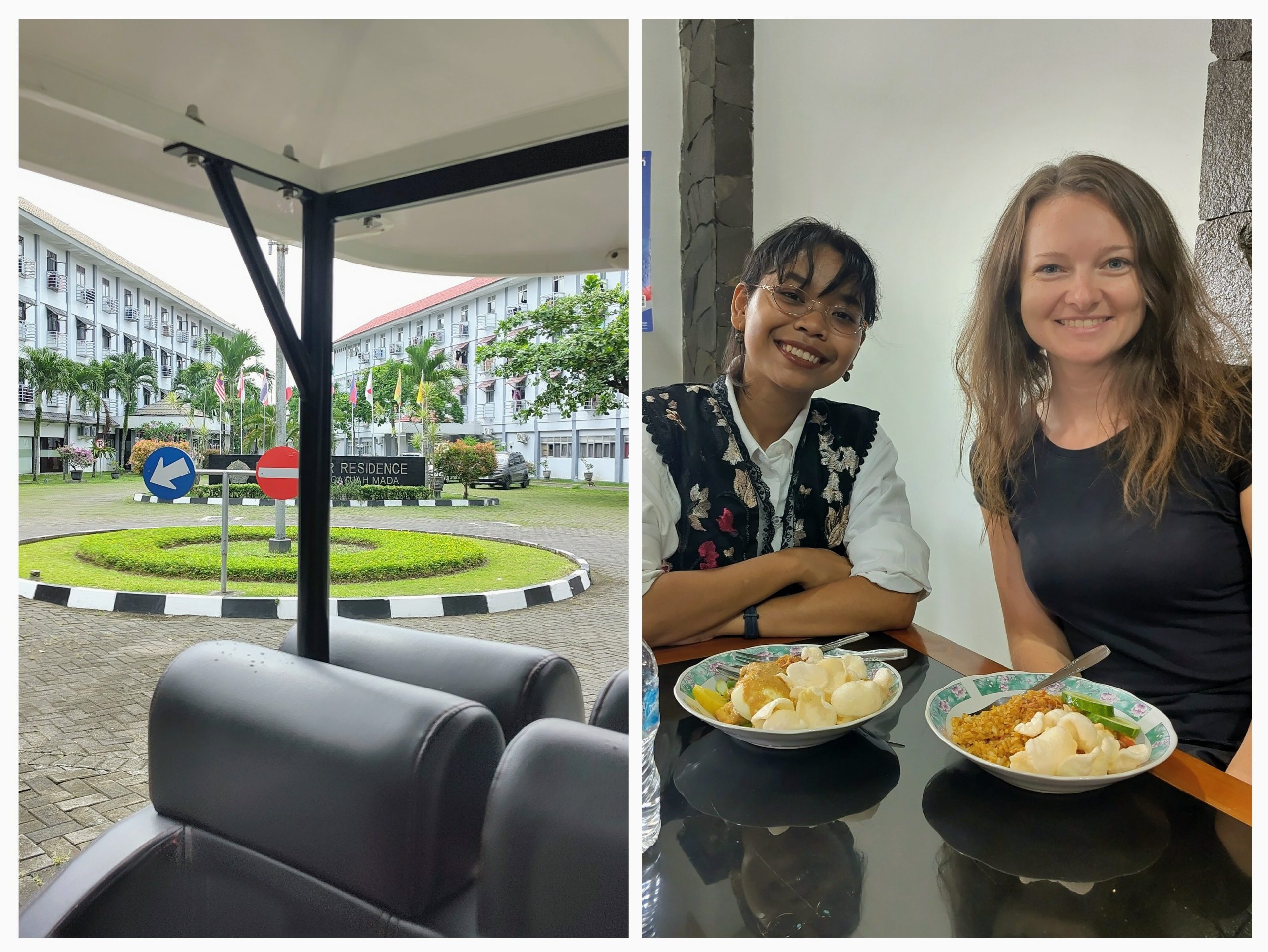
When we go outside, a bright red electric golf caddy with a driver is waiting. We weren’t expecting that! But we realize: it’s a good thing we don’t have to walk, as the campus, covering 360 hectares (!!), consists of 18 faculties, 2 schools and 22 research centers. We are also lucky with the weather: despite the rainy season starting, it’s dry and warm. All year round, it’s about 30° C here – Indonesians joke there are only two seasons: “Hot and hotter.”
During the ride, the literature student comments on the buildings and initiatives in beautiful English. What stands out: their own health center, a square with various prayer houses right next to each other, and the water treatment plant, which enables drinking water fountains across campus. UGM has set itself the goal of developing its campus into an “Educopolis” – with free electric buses, campus bicycles, solar panels, and trees, among others – and you can feel this project’s success. We feel absolutely at ease. We end the day at the canteen with a shared meal, surrounded by young people.
“We are overwhelmed by the first day.”–Jana Iljina
“We are exhausted, but happy.” –Elisabeth Mansel

Day 2 – Separate Ways
Today we split up – each goes to her own department, both inside the large, maze-like administration building: getting lost is almost guaranteed.
Department of Human Resources
Still filled with the euphoria of the previous day and the city’s hustle and bustle, I hop again into a Grab – by now as familiar as a daily companion. The drive to the university already feels surprisingly familiar, and the vibrant friendliness of the people soon brings a smile to my face.
At the HR department, I’m greeted very warmly and led to a prepared meeting room with a plate of local fruit awaiting me. The fresh lychees, especially, win me over – sweet, fragrant, and more intense than anything I know from Germany.
Shortly after, I meet the team lead, Erna Kartini – Training & Assessment Manager, HR Directorate at UGM, who throughout the day gives me broad insight into the workings of the HR department. Patiently and with pride, she explains the routines, responsibilities, and particularities of her area.
For lunch, food is ordered for everyone: crispy fried chicken, rice, and fresh mango pieces. We sit together at the table, share stories, and laugh. Our conversations range from private matters to cultural specifics, from family to work habits.
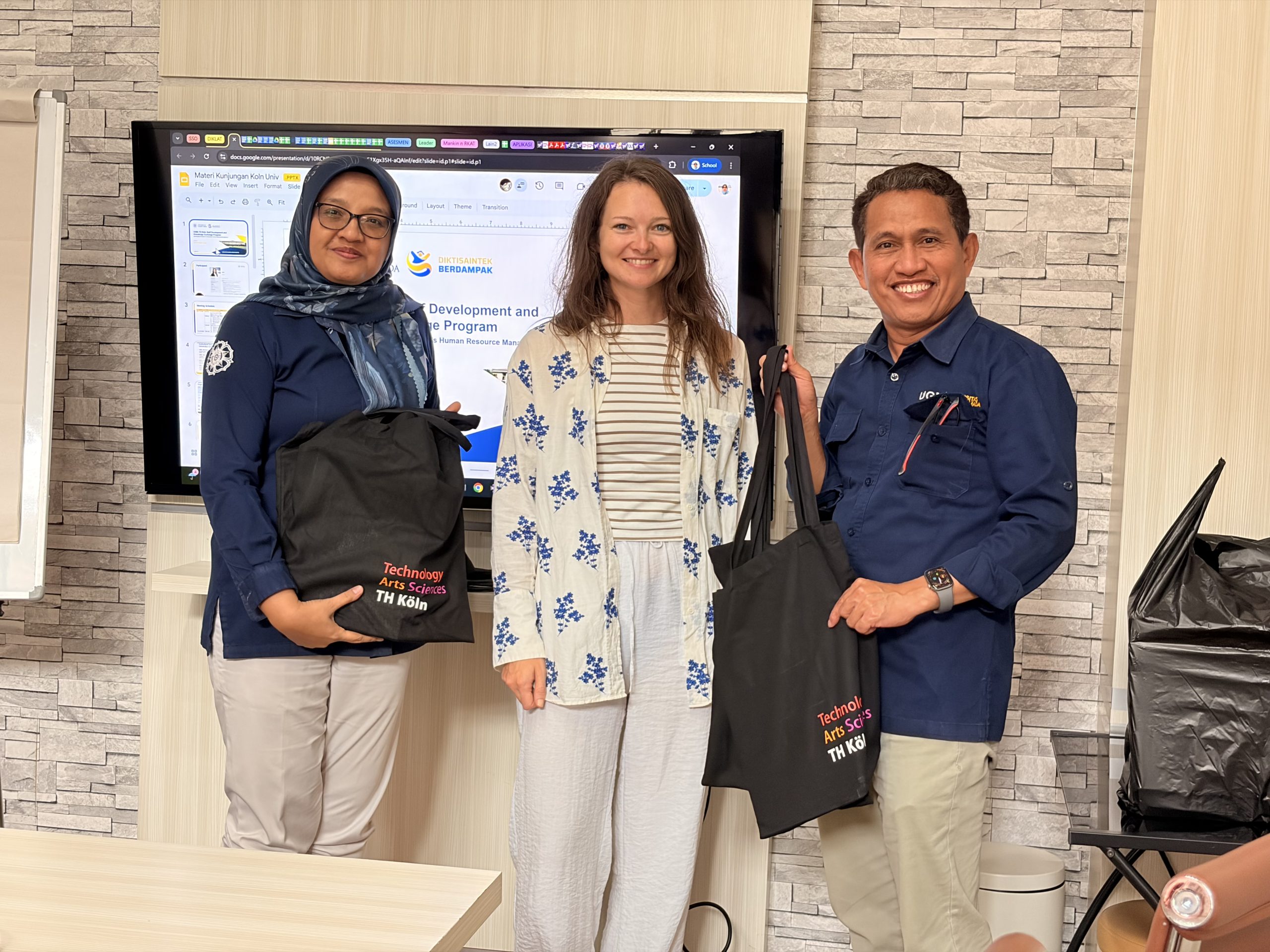
We talk about how it’s customary in Indonesia to receive gifts with both hands. In return, I show photos of the golden German fall – forests, mist, colored leaves. The enthusiasm is great, as many here know distinct seasons only from pictures. During the meal, the Head of Human Resources joins us, warmly greets me, and asks about my impressions so far. After lunch, I hand over goodie bags from TH Köln, which are quickly unpacked and admired. The Cologne cathedral model and vegan gummy bears are especially popular and quickly devoured.
Prayer Time – and Valuable Conversations In Between
After lunch, some staff members say goodbye for prayer time. They explain to me, very politely, how important this daily break is for them. While they are away, I continue conversing with the others about their daily lives and life in Yogyakarta.
Employer Benefits – Health Services and Wellbeing as Core Values
When everyone returns, the presentation continues – with a topic close to everyone’s heart. The team proudly tells me about their comprehensive health services:
- Free medical care
- Special health programs
- Preventive services
Notably, the HR department has its own in-house psychologist supporting staff. She tells me how much UGM values mental health in the workplace – not just as a vague concept, but as lived practice.
Wellbeing is clearly central. The team explains how closely they work together to foster a healthy, appreciative, and supportive work culture. For a university of this size, it’s remarkable – and inspiring.
A Day Full of Perspectives – and an Overwhelming Ride Back
In the afternoon the team gives me a warm farewell. With my head full of new impressions, perspectives, and encounters, I make my way back. So many faces, names, stories, and new viewpoints accompany me as I return to the hotel. Arriving in my room that evening, I’m overwhelmed – in the best possible way.
“How much you can learn from each other if you take the time to listen.”– Jana Iljina
In the Legal Department

Neysa takes me to the legal department and says goodbye. I’m a little nervous: Will I be understood? Will I understand them? What will we do?
Luckily, I’m warmly welcomed. Out of excitement, I start chatting right away and unpack our gifts (the cathedral model, TH merch, gingerbread, and Christmas stollen). Handshakes, smiles, trying to remember names. The encounter is open, warm, and at eye level from the beginning. My nervousness slowly disappears.
After a short round of introductions and an insightful presentation about the department at a long meeting table, it becomes clear: we have surprisingly many similarities in our work styles, tasks, and challenges. I’m thrilled by the openness with which I’m received. Out of curiosity, I ask what feels like a thousand questions – but no one seems to mind. And the language barriers I feared turn out not to be a problem.
At lunch, we walk past celebrating graduates with families – a common sight here, with so many students. Afterwards, we’re taken by golf caddy (this time white) to a restaurant. The Gado Gado tastes fantastic and rounds off my first day in the legal department perfectly.
Day 3 – On the Move Again, but More Relaxed
Department of Law and Organization
“The first time it’s an experiment, the second time a tradition, and the third time a custom!” –Elisabeth Mansel
So today, it’s almost a ritual as I make my way to UGM. I feel relaxed and cheerful, as do my colleagues. In further conversations, we continue to find many similarities, but also some interesting differences: for example, here parents are allowed to look at their children’s grades – unusual for us. I was also struck by the early retirement age (normally 58).
We end the day at My Kopi-O! with Sate Ayam and fruit bowls with durian (a fruit you either love or don’t). I find it delicious. During the meal, we talk about everything – from sports, traditions, origin and family to football clubs – and laugh a lot.
To say goodbye, I receive generous gifts, which makes me very happy and a little embarrassed – especially the sarong and bag will always remind me of my time here. Even though we didn’t have much time together, it feels as if we’ve known each other a long time.
Department of Human Resources
On our last day at Universitas Gadjah Mada, I am once again on my own. As before, I take a Grab in the morning – by now my trusted and simple mode of transport in Yogyakarta. I go to our agreed meeting point on campus, where Alvrista Reviana from HR greets me kindly.
We get into one of those red electric campus caddies, as we did before. Only this time, the tour is much more thorough, giving me new insights into the size, diversity, and atmosphere of UGM.
Alvrista starts by showing me the sports area. We drive around the large sports field, which is open to both students and staff. Everyone brings their own equipment – and the field is lovingly maintained. It’s a place where movement, community, and balance are clearly a big deal.
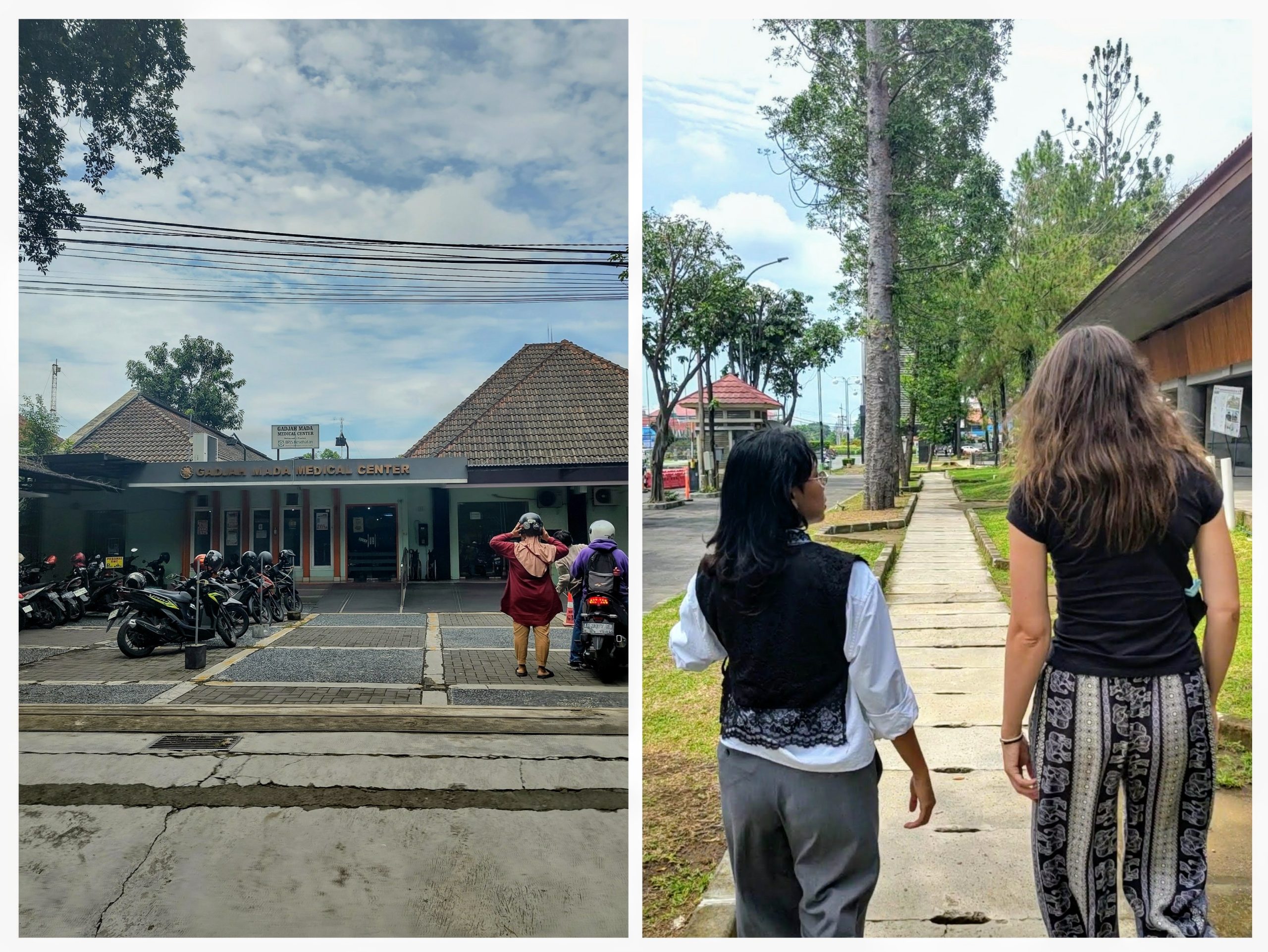
As we continue, Alvrista explains the campus structure. We pass various faculties, student and staff housing, and several central facilities. Especially interesting is the university clinic, where members can get medical help easily. Everything seems very well organized and focused on the needs of the people who learn and work here.
A highlight is definitely the visit to the university library, which Alvrista shows me not just from the outside, but inside as well. The library is a lively place:
- On each floor, there are cozy corners and workspaces.
- In special rooms, students can have snacks and meals.
- The book areas themselves remain quiet and focused.
Especially impressive is a section devoted to UGM’s history – with portraits and biographies of important personalities who shaped the university. A piece of living academic history.
They also show me the digital catalogue, through which historical books are gradually scanned and made accessible. A big project requiring great attention to detail, underlining the importance of archiving and preserving knowledge.
Finally, we walk together through the large administration building. Alvrista and her team ask me many questions about how universities work in Germany, how structures are set up, and which processes are typical. In return, they explain their own procedures, responsibilities, and particularities.
Conclusion – People, Encounters, New Perspectives
We’re still going to marvel at waterfalls, see volcanoes, and wake up on beaches in Indonesia – but the greatest gift for us remains the conversations and encounters with our UGM colleagues. The warm welcome at the International Office and the chance to get to know our “mirror” departments far from home allowed us to experience the culture and people in a very special and personal way.
What I take away is that universities everywhere in the world have this special, inspiring atmosphere that I love so much. And that legal departments, even with different frameworks, share the commitment to upholding legal principles like equal opportunity – facing similar challenges.
But most of all, I’m left with the experience that diversity and encounters are enriching. We’re all different, but essentially connected by so much – no matter where we come from. I hope we keep in touch and maybe meet again at our university someday.
A lively, open exchange emerges, showing that despite all cultural differences, other traditions, and a completely different environment, a university operates on the same basic principles everywhere. Administration, teaching, research, student support – all these serve a common goal: to enable education and accompany people on their path.
As I say goodbye in the afternoon and leave the campus for the last time, my mind is full of images, conversations, and insights. The visit showed me how similar we are – and how enriching the differences can be.
That evening at the hotel, I am once again overwhelmed by the feeling that education truly is a unifying language.

Written by: Jana Iljina and Elisabeth Mansel (TH Köln)
Recent Comments