• About UGM
  • IT Center
  • Webmail
Universitas Gadjah Mada Office of International Affairs
Universitas Gadjah Mada
  • Home
  • About US
    • OIA Profile
    • OIA Organizational Structure
    • About UGM
    • OIA Behind The Scene
  • Global Networks
    • International Collaboration
    • Existing Networks
    • Collaborate With Us
  • Admission
  • Opportunities
    • Incoming
      • Double Degree UGM
      • Scholarship
      • Summer Course
      • UGM-INCiTE Summer School 2026
    • Outgoing
      • Procedures
      • Scholarship and International Exposure
      • Fellowship
      • Research & Publication
      • Award
  • News Release
  • Contact Us
  • Beranda
  • #SummerCourseUGM2024
  • #SummerCourseUGM2024
Arsip:

#SummerCourseUGM2024

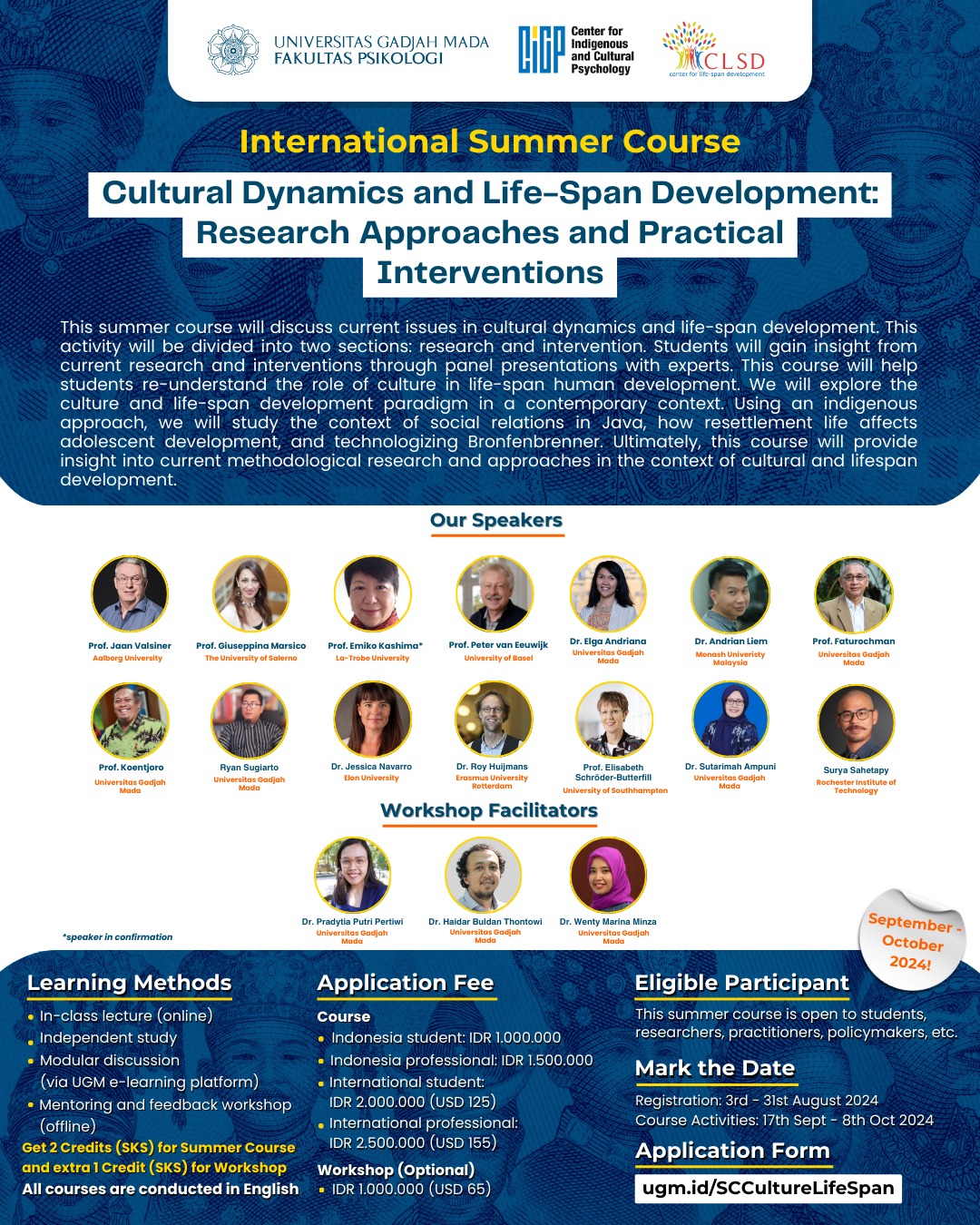
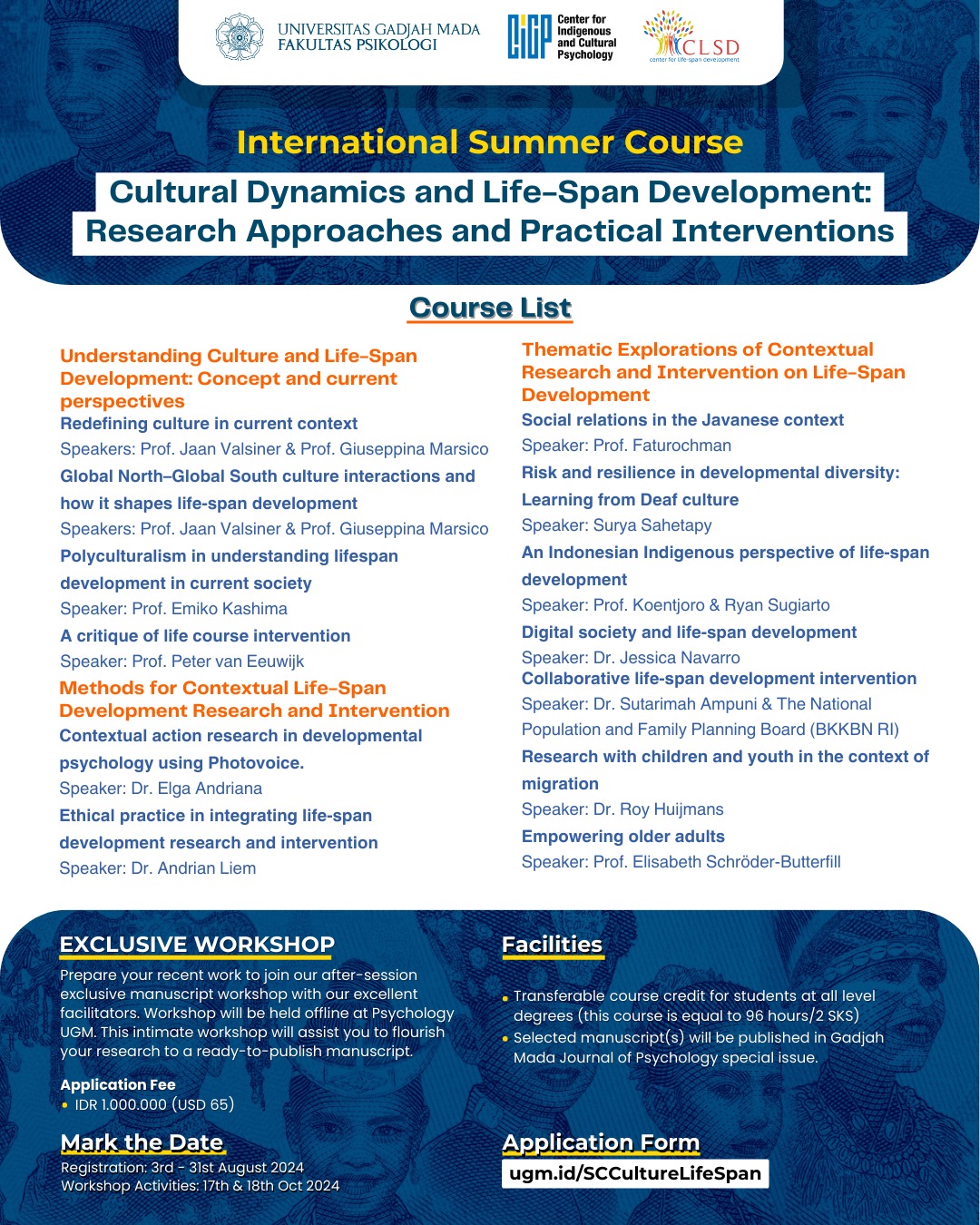
Summer Course on Cultural Dynamics and Life-Span Development: Research approaches and practical interventions

SlideSummer Course UGM Friday, 16 August 2024

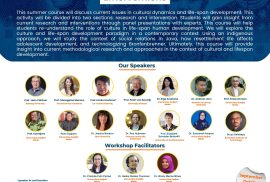
Collaborating with Indonesian and global experts, CICP & CLSD Faculty of Psychology Universitas Gadjah Mada officially presents Cultural Dynamics and Life-Span Development: Research Approaches and Practical Intervention.


[📝 PROGRAM]
16 lecture sessions (4 modules) present the latest advances in community research and intervention from a psychological and multidisciplinary perspective.


[👤 WHO SHOULD JOIN]
This summer course is open to students, researchers, practitioners, policymakers, and participants from other universities, both domestic and international with a limited quota.


[🗒 TIME AND PLACE]
September 17th – October 8th, 2024
via Zoom Meeting, eLOK, and Google Classroom


[💵 PARTICIPATION FEE]
Course
Indonesian students = IDR 1.000.000
Indonesian professionals = IDR 1.500.000
International students = IDR 2.000.000 / USD 125
International professionals = IDR 2.500.000 / USD 155
Manuscript Writing Workshop
All participants = IDR 1.000.000 / USD 65


[📁 FACILITIES]
– Certificate
– Transferable course credit for students at all level degrees (this course is equal to 96 hours/2 SKS)


Registration dates 1-31 August, 2024 through:
⬇⬇⬇
ugm.id/SCCultureLifeSpan

For more information about this program, please kindly check:
⬇⬇⬇
https://clsd.psikologi.ugm.ac.id/summer-course/


All session will be delivered in English. Closed captioning will be provided. Full and 50% scholarships are available.

Should you have further questions, do not hesitate to contact us at:
Email: cicp@ugm.ac.id | clsd.psikologi@ugm.ac.id
Website: ugm.id/CLSDSummerCourse
Instagram: @cicp.ugm | @clsd.ugm
Summer Courses 2024 Offers – Faculty of Psychology Universitas Gadjah Mada

SlideSummer Course UGM Thursday, 4 July 2024

Introduction

Household financial well-being is a critical and timely topic for several reasons. First, it directly impacts the quality of life for individuals (Mathew et al., 2024) and their families. It influences their ability to meet basic needs, access healthcare and education, and ensure a comfortable living environment. When households experience financial stress, it can lead to a range of negative consequences, including physical and mental health problems, family conflicts, and a decline in overall happiness (Ryu & Fan, 2023). At the macro level, household financial well-being significantly impacts the overall economic stability of a country. Financially secure and stable households are more likely to contribute positively to the economy through spending, savings, and investments (Cashin et al., 2001). Conversely, financially stressed households may require social assistance or contribute to economic downturns during financial crises.

Data suggests that Indonesian households face financial challenges, evident through various indicators. Firstly, the savings-to-GDP ratio remains relatively low compared to Singapore and the Philippines (Setiawan, 2016). Secondly, there has been a significant increase in the volume of consumer loans provided by commercial banks between 2015 and May 2020 (Otoritas Jasa Keuangan, 2020). Thirdly, there has been a rise in non-performing loans (NPLs) from 2015 to May 2020, as reported by Otoritas Jasa Keuangan (2020). Moreover, in 2020, most Indonesian households experienced financial difficulties, with 74.3% experiencing a decline in income, 24.4% facing increased expenses, 51.5% lacking savings as a safety net, 27.3% having to pawn assets to survive, and 25.3% seeking informal financial assistance from friends or relatives (UNICEF et al., 2021).

Consequently, policymakers are increasingly interested in developing effective policies to enhance household financial well-being, including initiatives related to financial literacy, consumer protection, retirement planning, and social safety nets (OJK, 2021). Research in this area can inform evidence-based policy decisions to improve the financial well-being of citizens.

Objective of the Summer Course

  1. To enhance the participant’s understanding of the multifaceted nature of financial well-being, including the psychological, economic, and social factors that influence it
  2. To equip participants with advanced research skills necessary for conducting high-quality research skills necessary for conducting high-quality research.
  3. To provide participants with insights from behavioral economics and psychology that are relevant to household financial decision-making.
  4. To encourage participants to explore multidisciplinary approaches, understanding how psychology and economics intersect in the study of household financial well-being.
  5. To explore the policy implications of research findings in the context of solving household financial well-being problems in Indonesia.
  6. To support participants in developing research proposals or projects.


Course Outline

  • August 5th : Introduction & Orientation
  • August 6th : Approach and Theory
  • August 7th : Research Approach & Measurement
  • August 8th : Research in Practice and Policy Implications
  • August 9th : Proposal Development & Research Collaboration

Time and Place

Date      : 5-9 Agustus 2024

Place     : Room A203, Faculty of Psychology Universitas Gadjah Mada

Organizing Comitte

SPEKTRUM (Studio Psikologi Ekonomi & Konsumen: Training – Research – Consumer Monitor) Faculty of Psychology Universitas Gadjah Mada

Aplication Period

Application submission is open until July 31st, 2024

Contact Person

081326089603 (Yose)

Further Information and Registration Form

https://linktr.ee/spektrumugm

Reference

Cashin, P., Mauro, P., Pattillo, C., & Sahay, R. (2001). Macroeconomic policy and poverty reduction.

Mathew, V., Santhosh Kumar P K, & Sanjeev M A. (2024). Financial well-being and its psychological determinants— An emerging country perspective. FIIB Business Review, 13(1), 42–55. https://doi.org/10.1177/23197145221121080

OJK, O. J. K. (2021). National strategy on Indonesian financial literacy 2021 – 2025.

Ryu, S., & Fan, L. (2023). The relationship between financial worries and psychological distress among U.S. adults. Journal of Family and Economic Issues, 44(1), 16–33. https://doi.org/10.1007/s10834-022-09820-9

Summer Course: Hydrogen’s Role in Energy Transition: Perspective and Challenges

SlideSummer Course UGM Tuesday, 2 July 2024

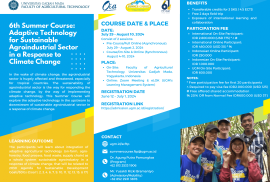
6th Summer Course: Adaptive Technology for Sustainable Agroindustrial Sector in a Response to Climate Change

SlideSummer Course UGM Friday, 21 June 2024

Course Description

In the wake of climate change, the agroindustrial sector is hugely affected and threatened, especially for tropical countries. The sustainability of agroindustrial sector is the way for responding the climate change, by the way of implementing adaptive technology. This Summer Course will explore the adaptive technology in the upstream to downstream of sustainable agroindustrial sector in a response of climate change.


Learning Outcome

The participants will learn about integration of adaptive agricultural technology (on-farm, agro-forestry, food process, food waste, supply chain) as a whole system sustainable agroindustry in a response of climate change, that will be related to 2030 Agenda for Sustainable Development Goals/SDGs (Goal 1, 2, 3, 4, 6, 7, 9, 10, 11, 12, 13, 15, & 17)


Course Date & Place

Date:

July 29-August 10, 2024


Consist of 2 sessions:

1. Pre-Course/Full Online: July 29-August 2, 2024

2. Course/On-Site & Online: August 4-10, 2024


Place:

On-Site: Faculty of Agricultural Technology, Universitas Gadjah Mada, Yogyakarta, Indonesia

Online: Zoom Meeting & eLOK (UGM’s Learning Management System)


Registration Date

June 12-July 1, 2024


Registration Link

https://admission.ugm.ac.id/registration/


Benefits

* Transferable credits for 3 SKS/4.5 ECTS

* Free 2 days field trip

* Exposure of international learning and collaboration


Fee

1. International On-Site Participant: IDR 2.800.000 (USD 175) * ^ #

2. International Online Participant: IDR 480.000 (USD 30) * %

3. Indonesian Online Participant: IDR 250.000

4. Indonesian On-Site Participant: IDR 1.000.000

5. UGM On-Site Participant: IDR 600.000


Notes:

* Free participation fee for first 20 participants

^ Required to pay visa fee IDR2.000.000 (USD 125)

# Free offered shared accommodation

% 20% Off from Normal Fee IDR600.000 (USD 36)


Contact

Dr. Agung Putra Pamungkas (Program) +62 813 2533 1906

Mr. Yusakti Rizki Bramantyo (Admission/Mobility) +62 852 2931 3678

Website: ugm.id/scftp

Email: summercourse.ftp@ugm.ac.id

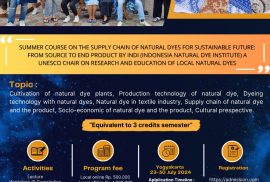
Summer Course on The Supply Chain of Natural Dyes for Sustainable Future: From Source to End Product by INDI (Indonesia Natural Dye Institute) a UNESCO Chair on Research and Education of Local Natural Dyes

SlideSummer Course UGM Thursday, 20 June 2024

Until now, Indonesia still imports synthetic dyes for fabric and yarn containing azo, aromatic amino, naptol, direct, acid, base, and reactive groups, in huge capacities. The use of this dye has been banned since 1996 in Europe. Indonesia has a cultural legacy from its ancestors of using natural dyes, which are safe and beneficial for the body. Apart from that, Indonesia also has abundant natural wealth and biodiversity which are raw materials for making natural dyes.

On a national scale, the production and application of natural dyes can contribute to realizing the National Industrial Development Master Plan (RIPIN) 2015 – 2035. In RIPIN it is stated that the environmentally friendly dye industry for fabric and thread and leather, as well as the development of a green industry based on domestic raw materials, is a program for national priority industrial development. Listening to the contents of RIPIN 2015-2035, there are five (5) factors in National Industrial Development, namely: 1). local culture and wisdom; 2). Human resources, 3). Natural resources, 4). Environmentally conscious, and 5). Technological innovation. Efforts to develop industry and reuse natural dyes in Indonesia, when compared with the five (5) factors in National Industrial Development, are very strong and have potential in the first to fourth factors. The contribution of universities and research institutions in technological innovation really supports the development of the fifth factor, technological innovation, of the natural dye industry in Indonesia. In the global realm, market competitiveness rests on superior products that utilize environmentally friendly technology, and there is a growing movement towards sustainable fashion, organic, slow fashion, and an emphasis on returning to nature.


  1. Objectives and Outputs of the Summer Course

Objectives of Summer Course activities :

1)     Increase knowledge and awareness of people throughout the world regarding the benefits of natural dyes for health and the environment;

2)     Increase the number of national and international students and young people to appreciate, be aware and proud of natural dyes,

3)     Develop a network and collaboration of natural dye lovers and users through interdisciplinary collaborative learning and research, to produce high-citation research and publications and superior innovation translations.

4)     Provide a platform for individuals and organizations to learn ab

out the applications of natural dyes for textiles, food, and leather;

5)     Achieve the goals of UNESCO Chair INDI in particular and INDI’s development master plan in general


After attending the “Capita Selekta Summer Course on Natural Dyes for Sustainable Development: From Upstream to Downstream by INDI (Indonesia Natural Dye Institute) – UNESCO Chair on Research and Education of Local Natural Dyes”, participants are expected to be able to:

1)     Explain the benefits and contributions of natural dyes to human

health and environmental safety.

2)     Identify and map sources of raw materials with an orientation towards the discovery or re-introduction of natural dye raw materials which takes into account the elements of availability (capacity), sustainability, non-damaging to the environment (Lestari), chemical, cultural, historical, theological, substantive and existing values.

3)     Explain and select the process and technology for making natural dyes (in textiles, food, leather), as well as making natural color pigments for various products. This study and research are connected between one domain and another, such as management of natural dye sources, technology, economy, and community culture.

4)     Explain and differentiate the technology of dyeing fabric, food, and leather with natural dyes. The technology here is both manual and mechanical, as well as to increase the quality of natural color strength in products by also paying attention to environmental, economic, political, social, and cultural aspects.

5)     Formulate solutions to challenges in changing the culture of reusing natural dyes as substitutes for synthetic dyes.

6)     Have the ability to learn and work collaboratively in an interdisciplinary and cross-cultural environment (setting).


  1. Time and Place

Date                    :    23 – 30 July 2024

Offline Place     :    Universitas Gadjah Mada (for the offline event)

Online                 : http://ugm.id/ZoomINDIUGM  (for the online event)


  1. Format of Summer Corse

Summer courses will be implemented using a hybrid method (combining offline and online participation) to expose as many participants as possible. The offline event will be held at Gadjah Mada University, host of INDI UGM. The speakers will come from invited speakers who represent to present material regarding natural dyes from each field.


  1. Organizing Committee

The head of the Organizing Committee is Prof. Catur Sugiyanto (Faculty of Economics and Business, Universitas Gadjah Mada).


Application Period 

Application submission is open until  June 27th, 2024.


Contact Person

Adhi Dwi Hatmanto, S.Si., M.Sc., Ph.D (+6281259897530)

Dr. Ing. AntoniusDimas Chandra Permana (+6285713486786)

Email: indi.lppt@ugm.ac.id


Link Website

https://indi.lppt.ugm.ac.id/


Smart City, Digital Transformation, and Society in Southeast Asia

SlideSummer Course UGM Tuesday, 28 May 2024

SMART CITY, DIGITAL TRANSFORMATION AND SOCIETY IN SOUTHEAST ASIA SUMMER COURSE 2024 is an summer course held by Center for Southeast Asian Social Studies, Universitas Gadjah Mada, since 2024. This program is designed for students, researchers, practitioners, or professionals who are interested in Smart City, Digital Transformation and Society Southeast Asia.

Technological advancements have ushered in an era of disruption, catalyzing profound shifts across diverse spheres of life. Among the most notable impacts is the rise of smart cities, a global phenomenon aimed at leveraging cutting-edge technology for regional advancement and digital transformation. Smart cities are characterized by their focus on enhancing efficiency, sustainability, and the overall quality of urban life, integrating technology into various aspects of society. Yet, amidst rapid technological progress, resource constraints, and intricate social dynamics, the imperative for inclusive, interdisciplinary dialogue looms large. Such discourse is essential to ensure that smart city initiatives in Southeast Asia are not merely aligned with global trends, but also rooted in the unique needs and nuances of the region and its inhabitants, fostering societal well-being and equitable development.


Program Period 

1 – 17 July 2024


Registration Period

Application submission is open until 24 June 2024.


Contact Person

Mellinia

085210219140

pssat@ugm.ac.id


Link Website

SUMMER COURSE 2024 SMART CITY, DIGITAL TRANSFORMATION AND SOCIETY IN SOUTHEAST ASIA

International Summer Course on Natural Cosmetic: Exploring Indonesian Beauty

SlideSummer Course UGM Thursday, 16 May 2024

The International Summer Course in Cosmetic: Exploring Indonesian Beauty, offered by the Faculty of Pharmacy, Universitas Gadjah Mada, leverages Indonesia’s rich natural resources and ongoing “Back to Nature” trend to provide an in-depth study of natural cosmetics development.

This year, our curriculum emphasizes natural product cosmetics, covering essential knowledge, research and development, regulations, and business innovation within the cosmetic industry. We are confident that this comprehensive program, blending online and in-person learning, will be an invaluable journey, offering new knowledge, skills, and lasting memories. Three weeks program, from July 15 to August 2, 2024, introduces a unique blended learning format that merges flexible online engagement with practical, hands-on activities. In the opening week, students can access our e-learning platform for asynchronous meetings, offering the flexibility to learn at their own pace and comfort, fostering a relaxed educational setting. The following week features a particular online session with expert speakers, providing an in-depth exploration of the course topics and a chance for direct interaction with leading professionals. The final week invites participants to our physical location for practical exercises in traditional cosmetic making and an educational field trip, enriching the learning experience with real-world application while exploring the beauty Indonesia has to offer.


Registration Period

Application submission is open until 30 June 2024.


Program Period

July 15 – August 2, 2024


Contact Person

summercourse.farmasi@ugm.ac.id

Link Website

https://summercourse.farmasi.ugm.ac.id

DCSE Summer Course on AI and Robotics 2024: Smart City Development to Support Sustainable Cities and Communities

SlideSummer Course UGM Wednesday, 8 May 2024

The DCSE Summer Course on AI and Robotics 2024 is an immersive program focused on smart city development. It explores innovative AI and robotics solutions to promote sustainable cities and communities. Participants will gain hands-on experience with cutting-edge technologies, delve into real-world case studies, and collaborate on projects that address urban challenges like traffic management, energy efficiency, and public safety.


Registration Period:

Application submission is open until 5th July 2024.


Program Period:

24 July – 3 August 2024


Contact Person:

Sonia Yunita

+62 81313138864

sonia.yunita@mail.ugm.ac.id


For more information, please refer to the link below:

https://summercourse.dcseugm.id/

Summer Course on Sustainable Tropical Agriculture 2024

SlideSummer Course UGM Wednesday, 8 May 2024

Faculty of Agriculture UGM proudly presents the fourth- year Summer Course with Sustainable Tropical Agriculture as the focus in 2024. The course is scheduled to take place from 15 July until 23 August 2024. We have 5 (five) sub-topics to be presented by the invited Speakers:

(1) Sustainable Tropical Agriculture

(2) Climate Resilient Farming in the Tropics

(3) Integrated Smallholder Plantation

(4) Innovative and Emerging Agricultural Technology and Management

(5) Socio-Economic and Cultural Dimensions in Tropical Agriculture The Summer Course is equal to 3 credits. Participants may include 3rd or 4th year undergraduate, master, doctorate students, and academic researcher.


Summer Course on Sustainable Tropical Agriculture 2024 will offer two program formats: online only and hybrid. The online program will provide learning resources such as lectures, independent research, group projects, and assignments. The hybrid program, in addition to the online resources, will also include field trips to provide students with practical exposure and hands-on learning opportunities. The Committee will provide hotel accommodation, meals, and local transportation during the field trip from 18 August until 24 August 2024. Travel/Flight cost to and from Yogyakarta, Indonesia is borne by the participants.


Registration Period:

Application submission is open until 10 June 2024.


Program Period:

July – August 2024


Contact Person:

Nur Akbar Arofatullah, Ph.D. (summercourse.faperta@ugm.ac.id)


For more information, please refer to the link below:

summercourse.faperta.ugm.ac.id

Global Summer Week 2024

SlideSummer Course UGM Thursday, 14 March 2024

Calling for Participants!

Faculty of Economics and Business (FEB) offers a various type of international program, including Dual Degree Program, Exchange Program, Short Program/Summer Course, Faculty Visit, and Faculty Exchange. For short program, FEB has a flagship summer course program known as International Week (iWeek) that was held since 2014 with various topics that highlighted the recent global issues. FEB has also cooperated with other partner university to hold summer program known as International Summer University (ISU) since 2010. After many years hosting international students to experience new knowledge from experts around the world and to explore culture in Yogyakarta through summer programs, FEB has designed a new concept of summer programs which will include various tracks and activities including Lecture, Company Visit, Credit Transfer, Summer Project, Cultural Event and Gala Dinner. FEB introduces to you Global Summer Week (GSW) which is a 2-week summer course program worth 3 credits (5 ECTS) per track. GSW will be held fully offline in Yogyakarta, Indonesia

Registration Period:
Visa-needed Students
Application: 15 February-31 March 2024
Payment: 15-31 March 2024

Non-visa-needed students
Application: 15 February-15 April 2024
Payment: 15 March-30 April 2024

Starting Date:
15-26 July 2024

Contact Person:
Email: iweek.feb@ugm.ac.id
IG: @feb.ugm

For more information, please refer to the link below:
https://iweek.feb.ugm.ac.id/

Recent Posts

  • UGM and Imperial College London Introduce Postgraduate Study Opportunities in STEM
  • [France] UniLaSalle – Summer Programs in Food as Medicine and Geological Field School.
  • [Tokai University] Open For Scholarship – 2027 MEXT Scholarship
  • Partnership Collaborate With Us 2026
  • [Germany] Hochschule München University of Applied Sciences – Exchange Program Summer 2027

Recent Comments

  • Janiece Gerke on [Korea] – Master of Arts in Asian Women’s Studies, Ewha Womans University
  • Renna Latchaw on [Malaysia] Universiti Utara Malaysia – Virtual Students Exchange Program for Fall 2020
  • Meruyert on [Japan] Kumamoto University – Student Exchange Program for Spring 2021
  • Mulatu Agajie on [South Korea] Seoul National University – SNU President Fellowship for Fall 2021
  • Zahira on [South Korea] Seoul National University – Student Exchange Program for Fall 2021
Universitas Gadjah Mada
Office Of International Affairs
Universitas Gadjah Mada
Bulaksumur F12-13-, Yogyakarta, 55281–
Incoming Students
Scholarship info
General Student Mobility Affairs
Incoming Lecturer and Researcher

+62 (274) 6492599

+62 (274) 565223

COOPERATION

  • Homeland Cooperation
  • Alumni
  • International Affairs

ABOUT UGM

  • Rector’s Words
  • History
  • Vision & Mission Statement
  • Pimpinan Universitas
  • Manajement

VISIT UGM

  • Campus Map
  • Agenda

REGISTRATION

  • Undergraduate
  • Graduate
  • Diploma
  • Profession
  • International

© 2024 Office of International Affairs

KEBIJAKAN PRIVASI/PRIVACY POLICY