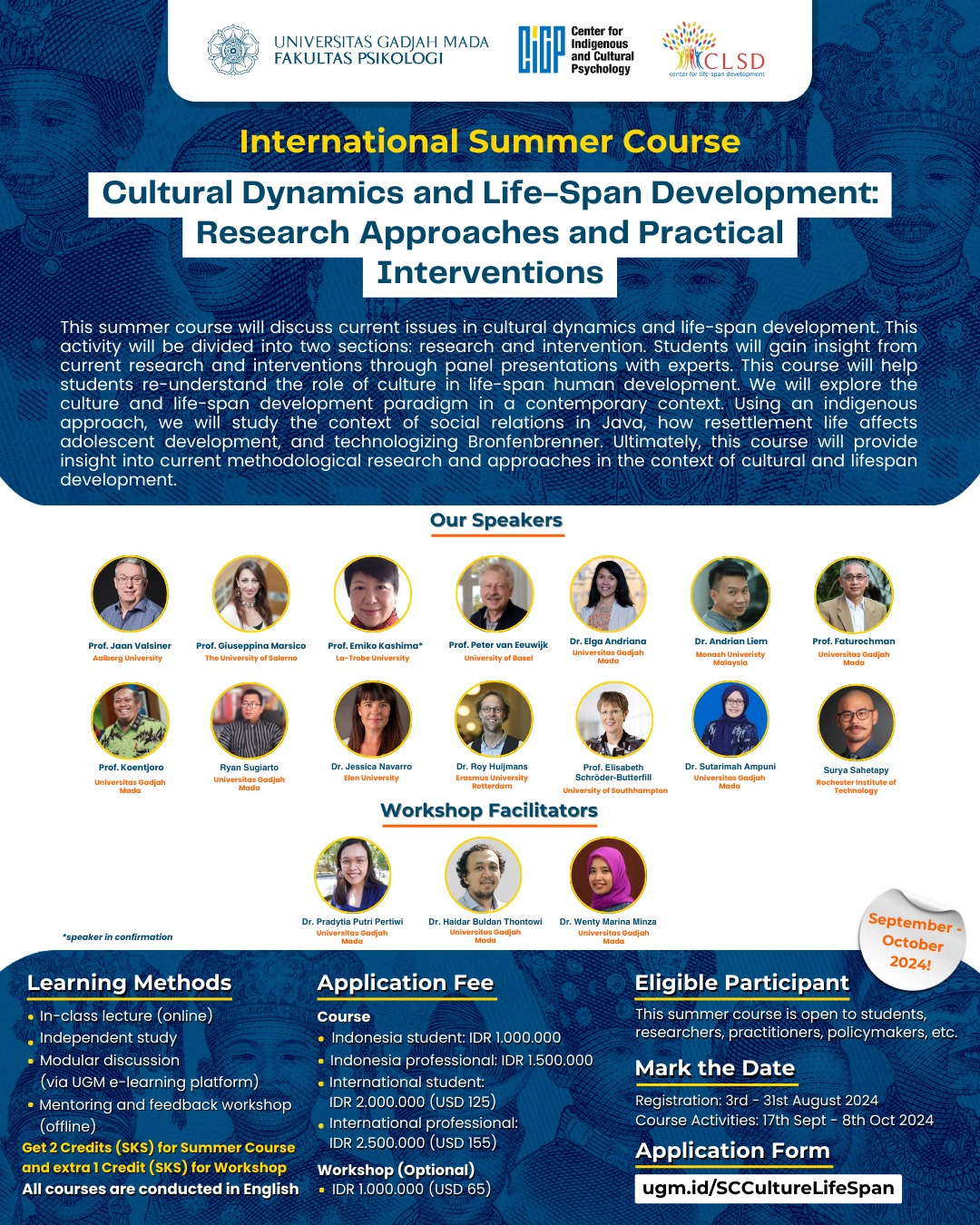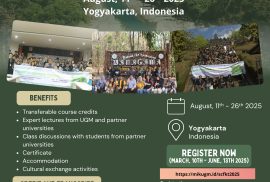
The Faculty of Forestry at UGM proudly presents The IX International Forestry Summer Course – The Forest Nexus: Innovation in Food, Energy, and Water Sustainability, a summer course focusing on a variety of study materials designed to integrate the multidimensional aspects of forests in supporting food, energy, and water sustainability.
Summer Course UGM
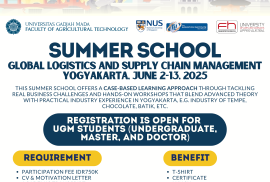
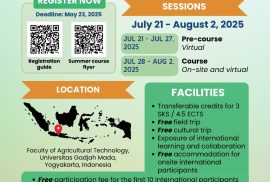
Faculty of Agricultural Technology, Universitas Gadjah Mada proudly presents Summer Course 2025 in Agri-food Sector: Artificial Intelligence Applications for Advancing the Agri-food Industry.
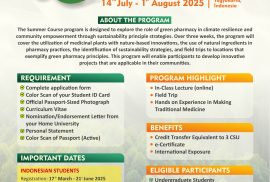
Faculty of Pharmacy in collaboration with Faculty of Medicine, Public Health, and Nursing Universitas Gadjah Mada proudly present Summer Course 2025 GREEN-HOPE: Harnessing Green Pharmacy for Climate Resilience and Community Empowerment.
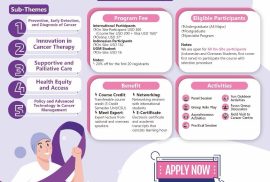
Faculty of Medicine in collaboration with Faculty of Dentistry, Faculty of Pharmacy, and Faculty of Psychology Universitas Gadjah Mada proudly present Summer Course 2025 on Interprofessional Healthcare – Integrative Cancer Management: A Roadmap to Better Outcome.
Introduction
Household financial well-being is a critical and timely topic for several reasons. First, it directly impacts the quality of life for individuals (Mathew et al., 2024) and their families. It influences their ability to meet basic needs, access healthcare and education, and ensure a comfortable living environment. When households experience financial stress, it can lead to a range of negative consequences, including physical and mental health problems, family conflicts, and a decline in overall happiness (Ryu & Fan, 2023). At the macro level, household financial well-being significantly impacts the overall economic stability of a country. Financially secure and stable households are more likely to contribute positively to the economy through spending, savings, and investments (Cashin et al., 2001). Conversely, financially stressed households may require social assistance or contribute to economic downturns during financial crises.
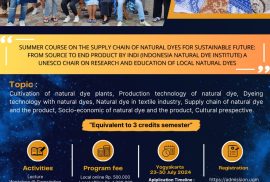
Until now, Indonesia still imports synthetic dyes for fabric and yarn containing azo, aromatic amino, naptol, direct, acid, base, and reactive groups, in huge capacities. The use of this dye has been banned since 1996 in Europe. Indonesia has a cultural legacy from its ancestors of using natural dyes, which are safe and beneficial for the body. Apart from that, Indonesia also has abundant natural wealth and biodiversity which are raw materials for making natural dyes.

Recent Comments